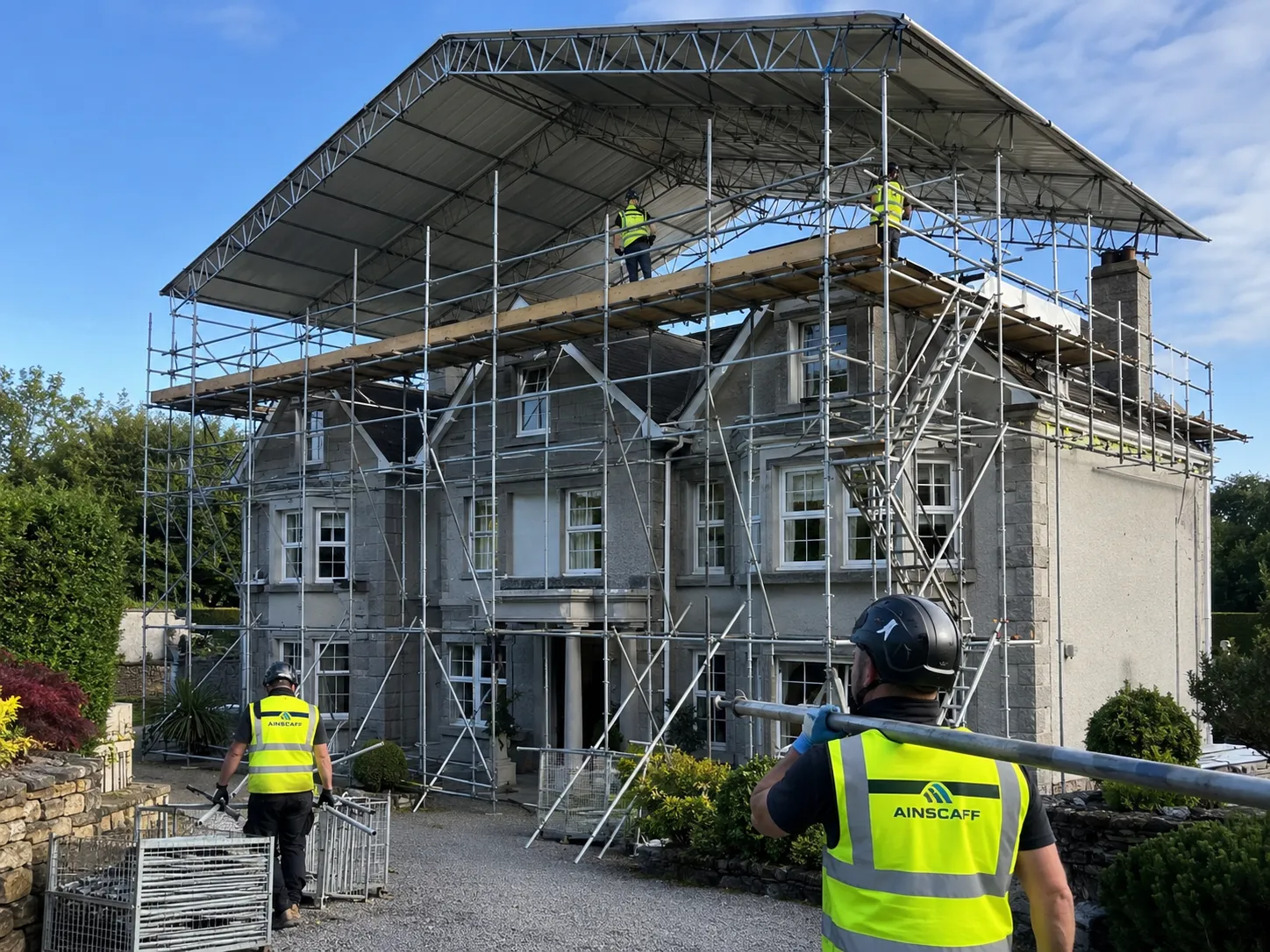
Ireland’s climate makes weather protection scaffolding, temporary roofs, one of the most practical tools in construction and restoration. A temporary roof scaffold allows work to continue in rain, protects a stripped or partially stripped roof deck from further water ingress, provides a controlled environment for heritage restoration, and protects a property’s contents and structure during insurance restoration projects.
Ainscaff Scaffolding designs, engineers, and erects temporary roof systems across Ireland. With depots in Dublin, Cork, and Galway, Ainscaff is one of the few Irish contractors with both in-house structural engineering and the operational capacity to deliver large temporary roof structures at short notice, including emergency response following fire and flood events.
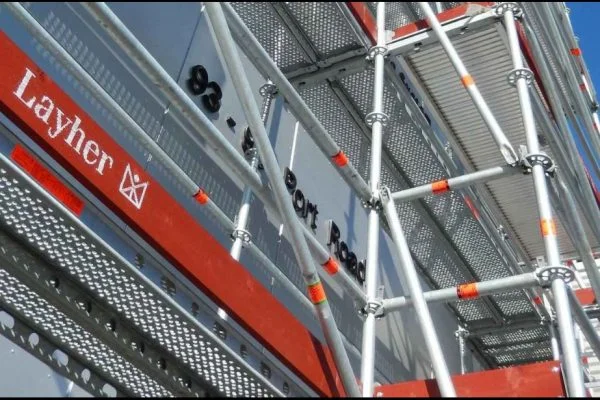
Ainscaff provides temporary roof scaffolding systems across Dublin and Ireland, delivering complete weather protection for construction, renovation and industrial sites of all sizes. Using the Layher system, our temporary roofs are engineered for wide spans, fast installation and compliance with Health and Safety Authority (HSA) guidelines. Suitable for domestic reroofs, commercial new builds, and public events. Free site surveys available nationwide – call 015443232.
AinScaff Scaffolding temporary roofs enable us to offer full weather protection and containment throughout the duration of your project. Our temporary roof installations provide our clients with a high degree of versatility and can encompass wide roof spans and complex professional applications.
The use and installation of a temporary roof can enable workers to carry on within a comfortable working environment and maintain high levels of productivity, regardless of any weather conditions that may otherwise hinder progress. Temporary roofs are in many cases an essential part of a major project or new build contract. Our temporary roofing provides protection against things like weather and dust, as well as other things you may not think of like noise on construction and industrial sites.
Roof Scaffolding
In-house structural engineers: bespoke temporary roof design and load calculations
Modular aluminium temporary roof systems: rapid deployment, any span
Shrink-wrap cladding available: full weather seal for sensitive structures
Emergency response capability: fire and flood restoration projects
Heritage project experience: temporary roofs over listed and protected structures
Nationwide: Dublin, Cork, Galway depots, all 26 counties covered
What Is a Temporary Roof Scaffold?
A temporary roof scaffold (also called a scaffold temporary roof, weather protection scaffold, or roof protection scaffold) is a structural frame erected over a building or structure to provide a weatherproof covering while roof work is carried out below. It is not a permanent structure; it is designed to be erected for the duration of the project and dismantled on completion.
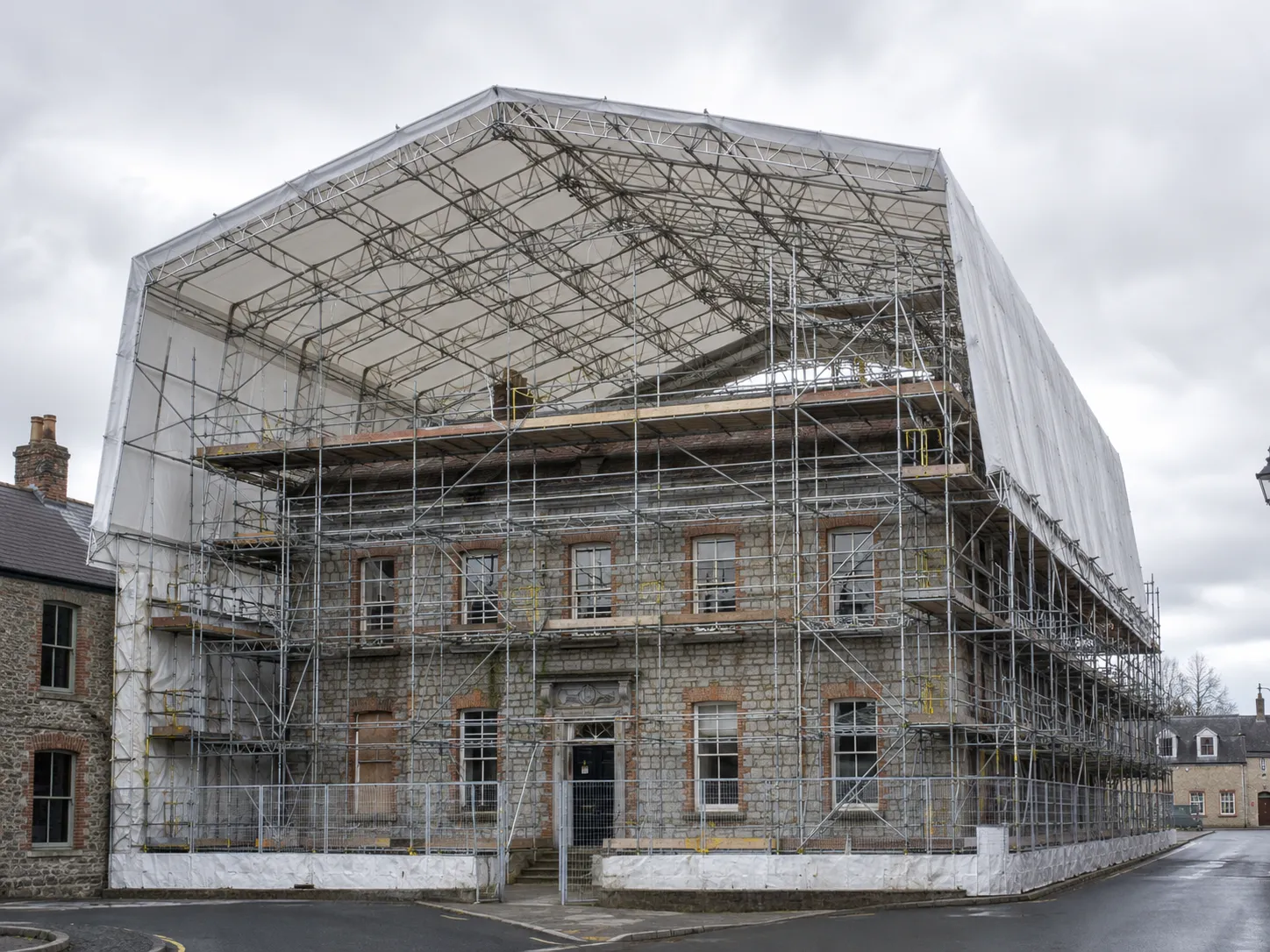
A temporary roof scaffold typically consists of a base scaffold structure built up from the ground in the same way as a conventional access scaffold, a roof frame supported by the scaffold structure spanning the required area, and a roof covering (either solid aluminium or steel sheeting, polycarbonate translucent sheeting, or specialist PVC shrink-wrap membrane) fixed to the frame to provide the weather seal.
The result is a covered working area that allows operatives to work on the roof deck, roof structure, or building interior regardless of rainfall. In Ireland, where annual rainfall averages 800-1,400mm depending on location and where prolonged dry periods cannot be relied upon, a temporary roof is often not a luxury; it is a practical necessity for any project where roof work cannot be completed within a single dry-weather window. Temporary roof systems provide essential protection during construction and refurbishment projects, while contractors should also consider roof work safety requirements when planning work at height.
What Does a Temporary Roof System Do?
Creates a fully enclosed, weatherproof working environment over any roof or structure
Protects workers, materials and existing structure from rain, wind and UV exposure
Reduces noise and dust contamination on sensitive or occupied sites
Allows roofing, timber, and masonry work to continue in any weather
Complies with HSA temporary works guidelines and European scaffold standards
Why Irish Construction Projects Need a Temporary Roof
Ireland’s weather is one of the most unpredictable in Europe. Rain, high winds and sudden cold snaps can bring a construction site to a standstill, costing contractors time and money every single day. A professionally installed temporary roof eliminates that risk, keeping your workforce productive and your project on schedule regardless of conditions outside.
Whether you’re managing a major roof replacement in Dublin, a phased refurbishment in Cork, or a new build in Galway, Ainscaff’s temporary roofing scaffold systems deliver a reliable, weatherproof enclosure from day one. Our team has been installing temporary roofs across Ireland for over a decade, backed by three generations of scaffolding expertise.
The use of a temporary roof can be a great idea in cases where there is concern about potential weather hazards impairing the progress of a project. It can be a welcome addition to a scaffolding construction and can mitigate a lot of weather related risk. Temporary roofs can also be very useful in cases where shelter is needed at public events. Weather in Ireland is unpredictable at best, so having our skilled team of scaffolding engineers install a temporary roof can oftentimes be advisable across many different construction sites.
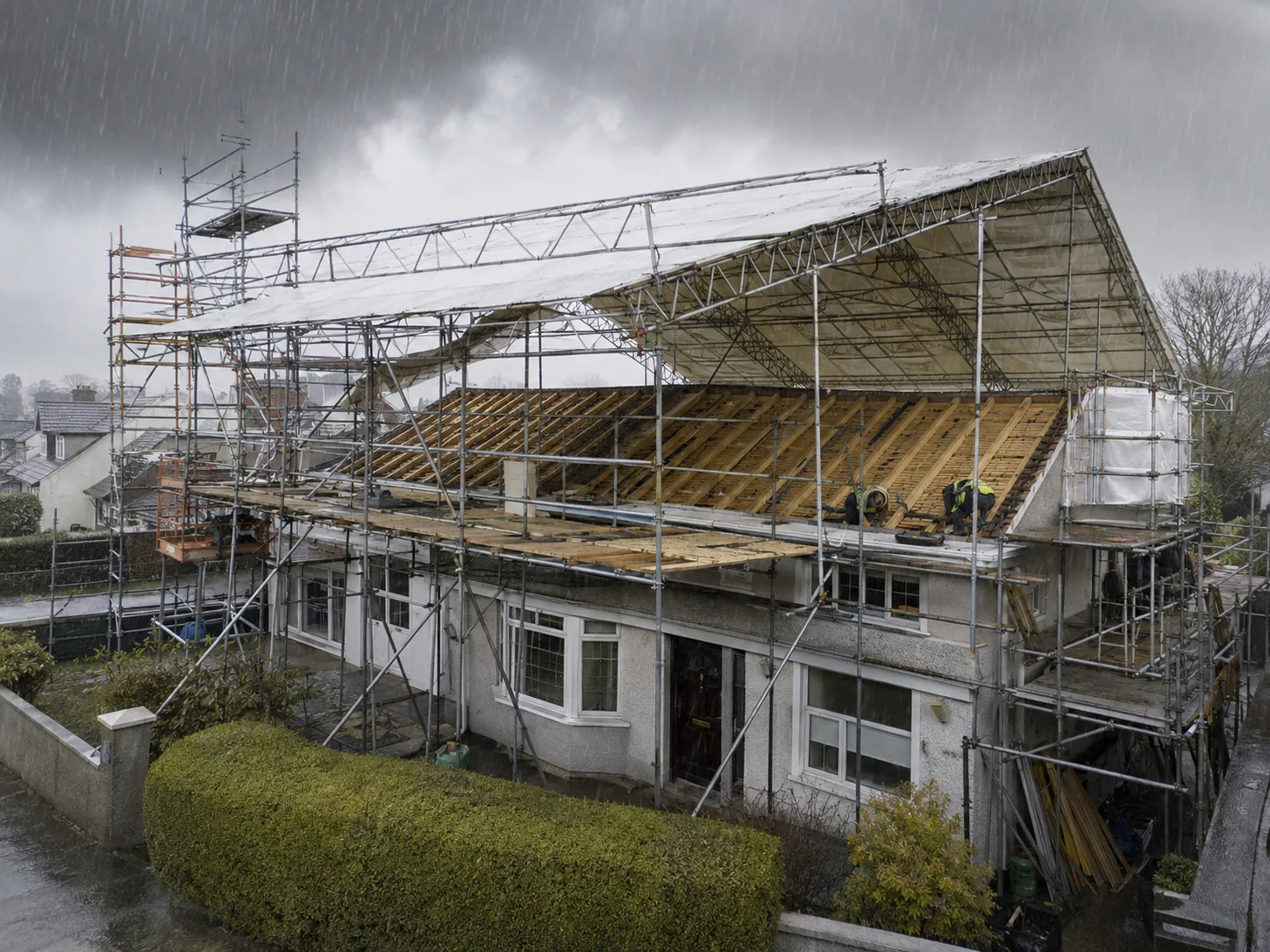
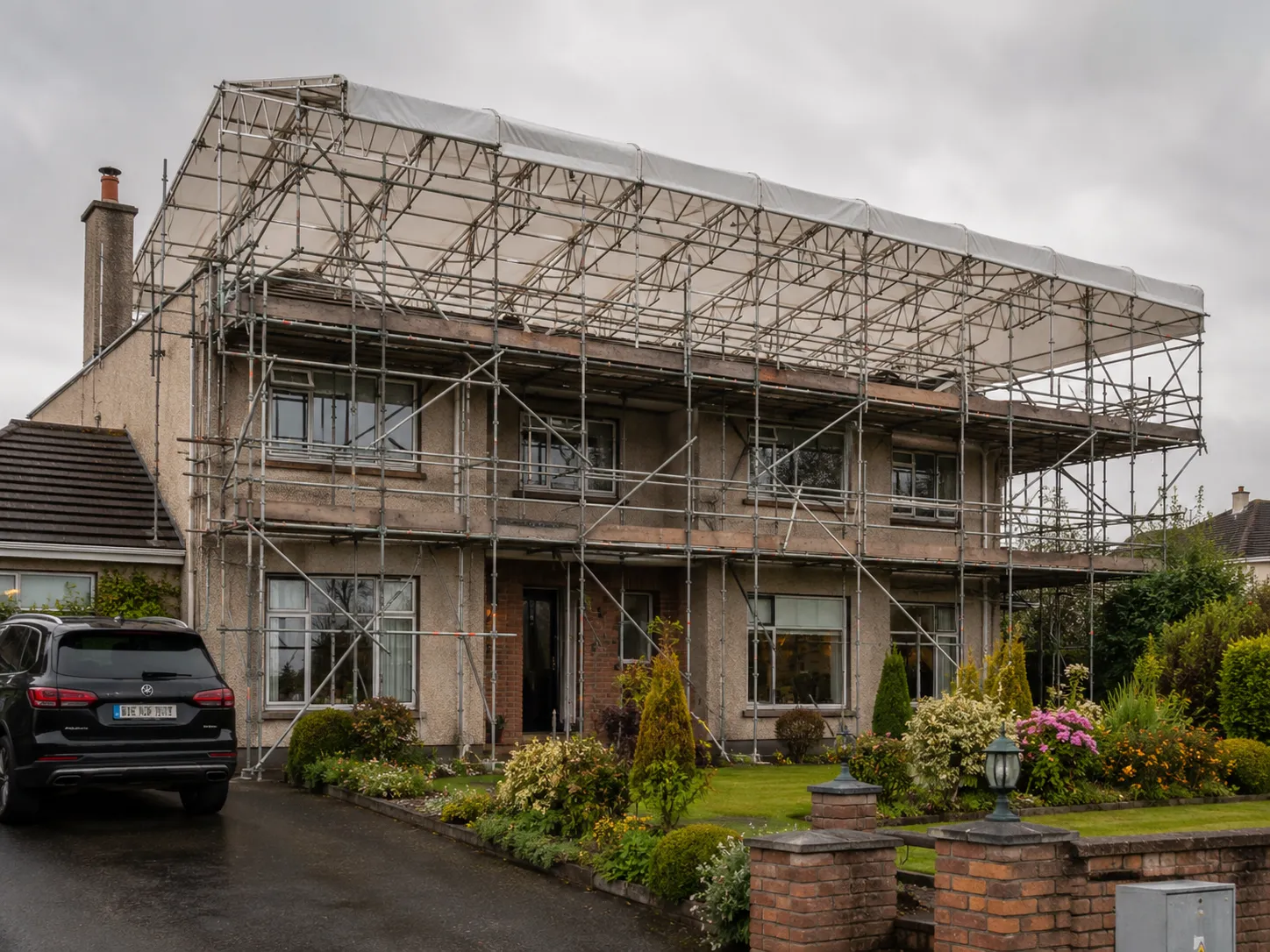
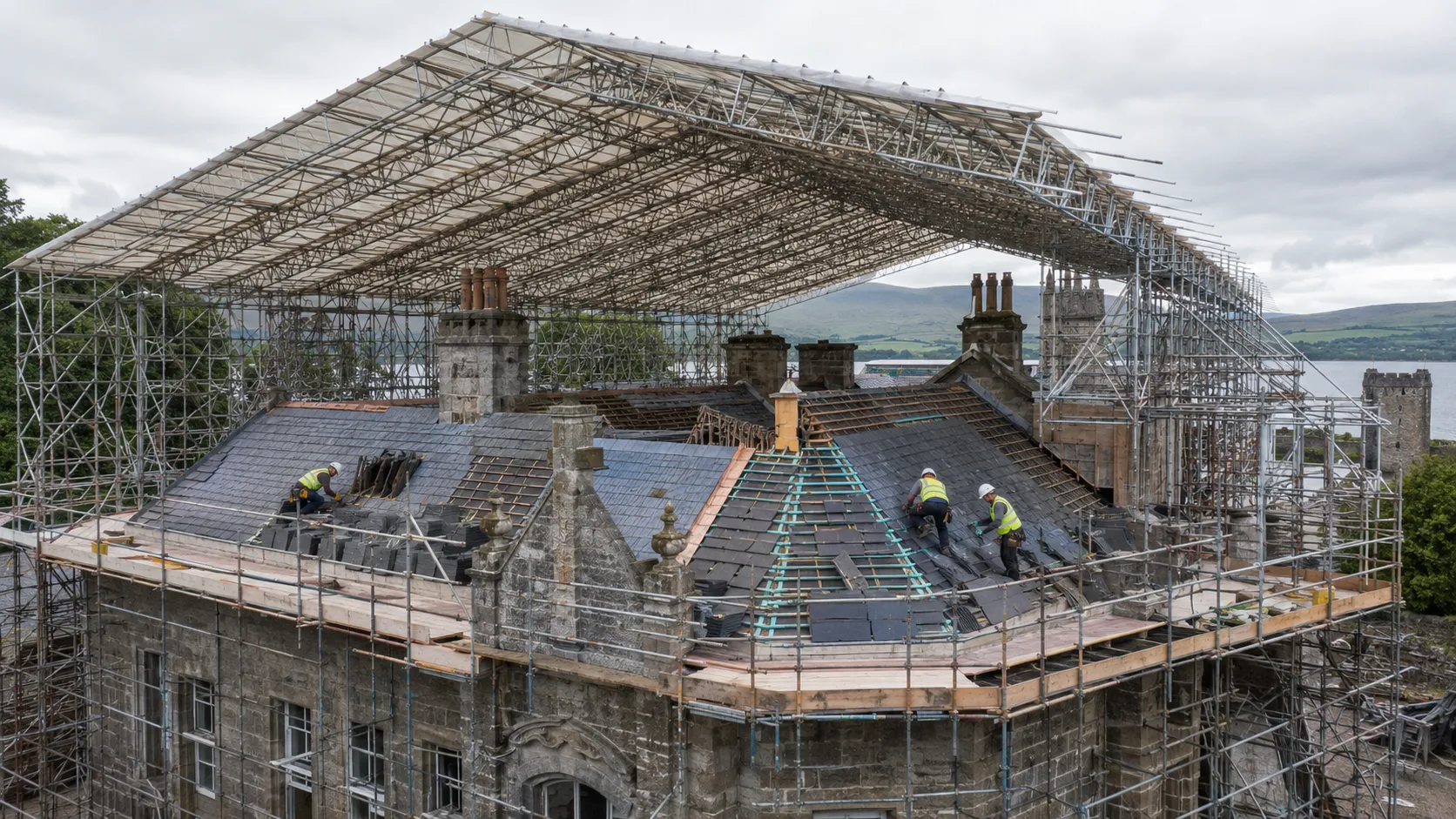
A temporary roof scaffold over a full residential re-roofing project, protecting the exposed roof deck from heavy rain.Ainscaff crews erecting a temporary roofing system on an Irish construction site.
The Core Question: What Happens if It Rains?
The easiest way to decide whether you need a temporary roof is to answer this question: if it rains heavily for 3 days during my project, what damage occurs and what does it cost to put right?
Project Type
Exposure if Unprotected
Temporary Roof Needed?
Ainscaff Approach
Full re-roof - all tiles/slates stripped
Roof deck and building interior fully exposed. 3 wet days = significant water damage to ceilings, walls, insulation.
Yes - strongly recommended or essential
Standard modular aluminium system over access scaffold. Span designed to building width.
Partial re-roof - section stripped at a time
Manageable exposure if phased carefully and dry conditions persist. High risk in autumn/winter.
Strongly recommended in Oct-Mar; advisable year-round
Structural works require removal of covering over a wide area for extended periods.
Yes - essential for any structural work spanning more than a few days
Custom-span temporary roof with access scaffold below for structural works.
Chimney rebuild or major repointing
Minor exposure at chimney level. Not usually requiring full temp roof.
Not usually required - chimney flashing and tarpaulin often sufficient
Confirmed at free site survey.
Fire damage restoration
Fire-damaged roof must be removed entirely; secondary water damage is a major concern.
Yes - essential. Emergency deployment required.
Emergency deployment capability. Rapid response for insurance restoration projects.
Flood or storm damage
Damaged or displaced roof sections expose the building to further ingress.
Yes - emergency response. Claim may cover cost.
Temporary roof combined with dehumidification access platform where required.
Heritage slate / clay tile re-roofing
Heritage materials are removed and relaid carefully; timescale is extended; building may be occupied.
Yes - strongly recommended; building may contain sensitive contents
Bespoke design for restricted loading. In-house engineers provide heritage-compatible solutions.
Dormer window installation
Cutting into the roof slope exposes the building to weather while the dormer is constructed.
Advisable. Temp roof reduces risk significantly.
Confirmed at free site survey.
Commercial or industrial planned works
Large commercial or industrial roofs cannot be stripped in one operation; phased working is required.
Yes - allows phased working without disruption to operations below
Large-span systems available for industrial and commercial applications.
Full house external works only (no roof opened)
No roof exposure - works are below the existing roof.
Not required
Access scaffold only.
The Irish Weather Factor
The case for a temporary roof in Ireland is stronger than in most European countries for a simple reason: Ireland’s rainfall is not seasonal in the same way as Continental Europe. Ireland does not have a dry summer period of 3-4 months during which roofing work can be planned with confidence. Rain is possible in any month, and autumn and winter bring extended wet periods.
Location
Average Annual Rainfall (mm)
Wettest Month
Dry Month Probability
Dublin (east coast)
730 mm
October / November
August statistically driest (50-60mm), but no month reliably dry
Cork (south)
1,000-1,200 mm
December
July-August drier but 70-90mm still typical
Galway (west)
1,100-1,400 mm
December / January
June drier but 70-80mm typical; extended dry periods uncommon
Ireland rainfall risk for roofing works
These figures mean that even in Dublin - Ireland’s driest major city - roofing works lasting more than 2 weeks face a significant probability of encountering at least one day of heavy rainfall that would cause measurable damage to an unprotected building. For projects on the west and south coasts, this probability is substantially higher.
Where a Temporary Roof Matters Most
Re-roofing an occupied propertyIf the property will remain occupied during re-roofing works, a temporary roof is the responsible choice. It removes the risk of water entering the occupied space, protects the occupants' belongings, and avoids the disruption and cost of emergency water damage repair during the works.
Insurance restorationFor properties that have suffered fire or flood damage, preventing secondary water damage is often the most time-critical action on the restoration programme. A temporary roof erected within 48-72 hours of the initial event can prevent water damage that would otherwise cost multiples of the temporary roof cost to repair. Insurance loss adjusters routinely recommend or require a temporary roof as the first action on fire-damaged properties.
Heritage propertiesListed and protected structures - properties on the Record of Protected Structures - require particular care during roof works. Heritage roofing materials (natural Welsh or Bangor Blue slate, clay plain tiles, Colly Weston stone slates, traditional lead) are often irreplaceable. A temporary roof allows heritage materials to be carefully removed, stored, sorted, and relaid at the appropriate pace, without pressure from weather exposure.
Planned commercial or industrial shutdownsFor industrial and commercial properties, planned roof maintenance or replacement during a shutdown window must be completed within the planned period. A temporary roof allows the phasing of roof works across a wider area than could be completed in a single good-weather window - and insulates the project programme from weather disruption that would cause cost overruns or restart of occupied operations in an incomplete state.
When a Temporary Roof Is Not Required
External facade works only - where the roof is not stripped or opened, there is no need for weather protection above standard access scaffolding
Minor chimney repairs - flashing repair, repointing, pot replacement - where the roof covering itself is not removed; a weatherproof tarpaulin over the chimney opening is often sufficient
Works of very short duration (1-2 days) in settled weather with weather forecast checked - acceptable risk management for minor roof patch works by experienced roofers
Flat roof works - flat roof systems are typically replaced in sections and sealed as work progresses; a temporary roof is rarely needed for flat roof replacement
Not Sure If Your Project Needs a Temporary Roof?
Our engineers will assess your roof span, site access and exposure, then tell you plainly whether weather protection is worth it for your works. Free site survey, no obligation, anywhere in Ireland.
The most widely used temporary roof system in Ireland is the modular aluminium system, a proprietary or bespoke aluminium lattice frame supported on the access scaffold structure, clad with aluminium or steel sheet roofing panels. Modular aluminium systems are:
Available in standard spans (typically 6m, 8m, 10m, 12m) and bespoke spans for larger buildings
Quick to erect: standard residential spans can be covered within a day by an experienced crew
Adaptable: gable and hip configurations available; ridged and mono-pitch options
Durable in wind: designed to Irish wind load requirements, with wind load calculations provided
Reusable: aluminium components are recovered and reused across multiple projects
PVC Shrink-Wrap Cladding
An alternative to solid sheeting is PVC shrink-wrap cladding, a specialist heat-shrunk membrane applied over a scaffold frame, creating a fully enclosed weather seal. Shrink-wrap is used where:
The roof shape is irregular or complex (gable returns, dormers, stepped rooflines) that make standard sheeting difficult to seal
A fully enclosed environment is required, for example to contain dust, debris, or hazardous materials, or to provide a thermally sealed workspace in winter
The project is small in area and a full aluminium temporary roof system would be disproportionate
Shrink-wrap is applied by specialist trained operatives using heat guns. When correctly applied it provides a complete weather seal. It is not reusable; it is cut away on dismantlement. A comparison of temporary roof systems vs shrink-wrap is available at our temporary roof vs shrink wrap guide.
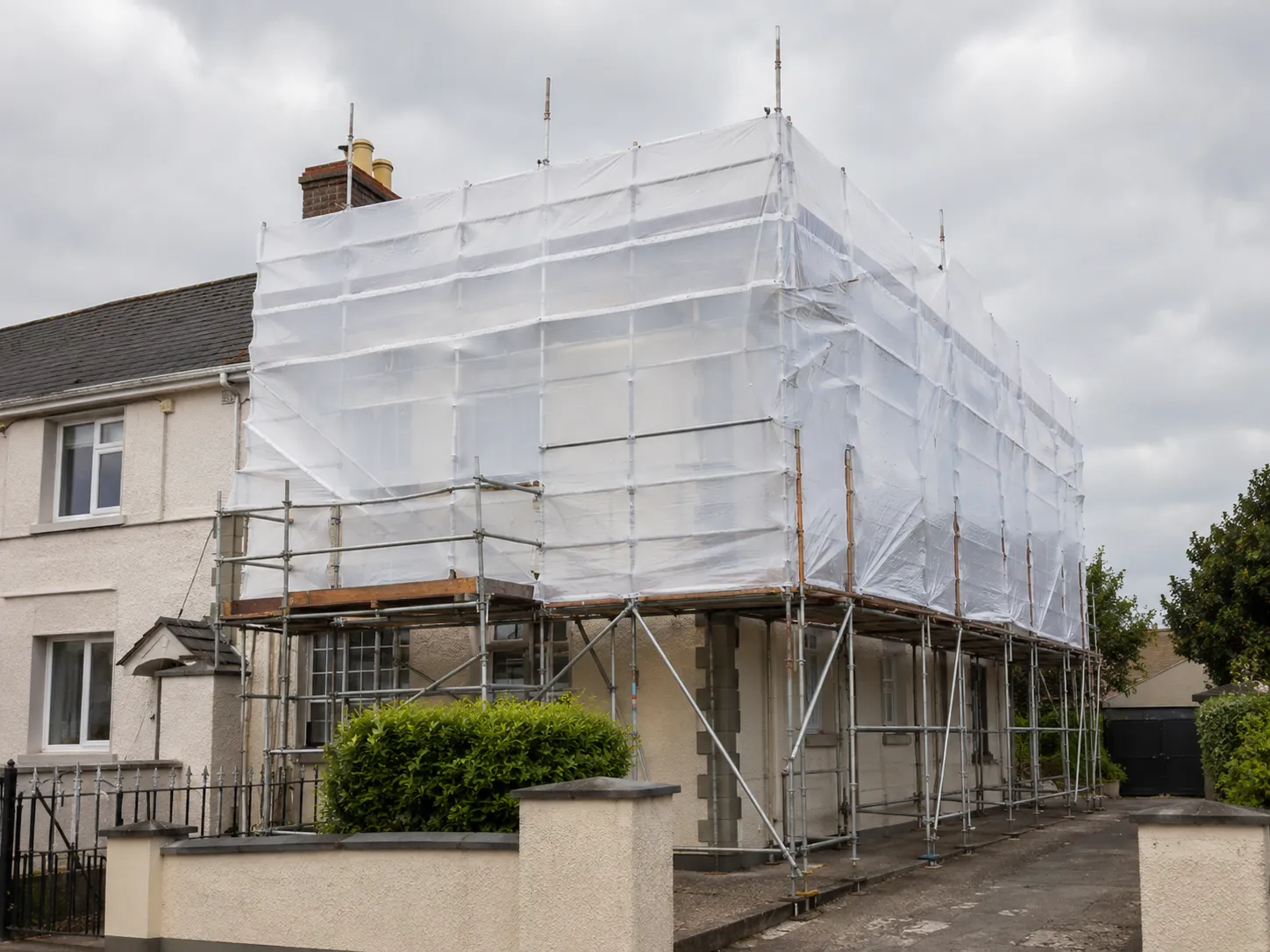
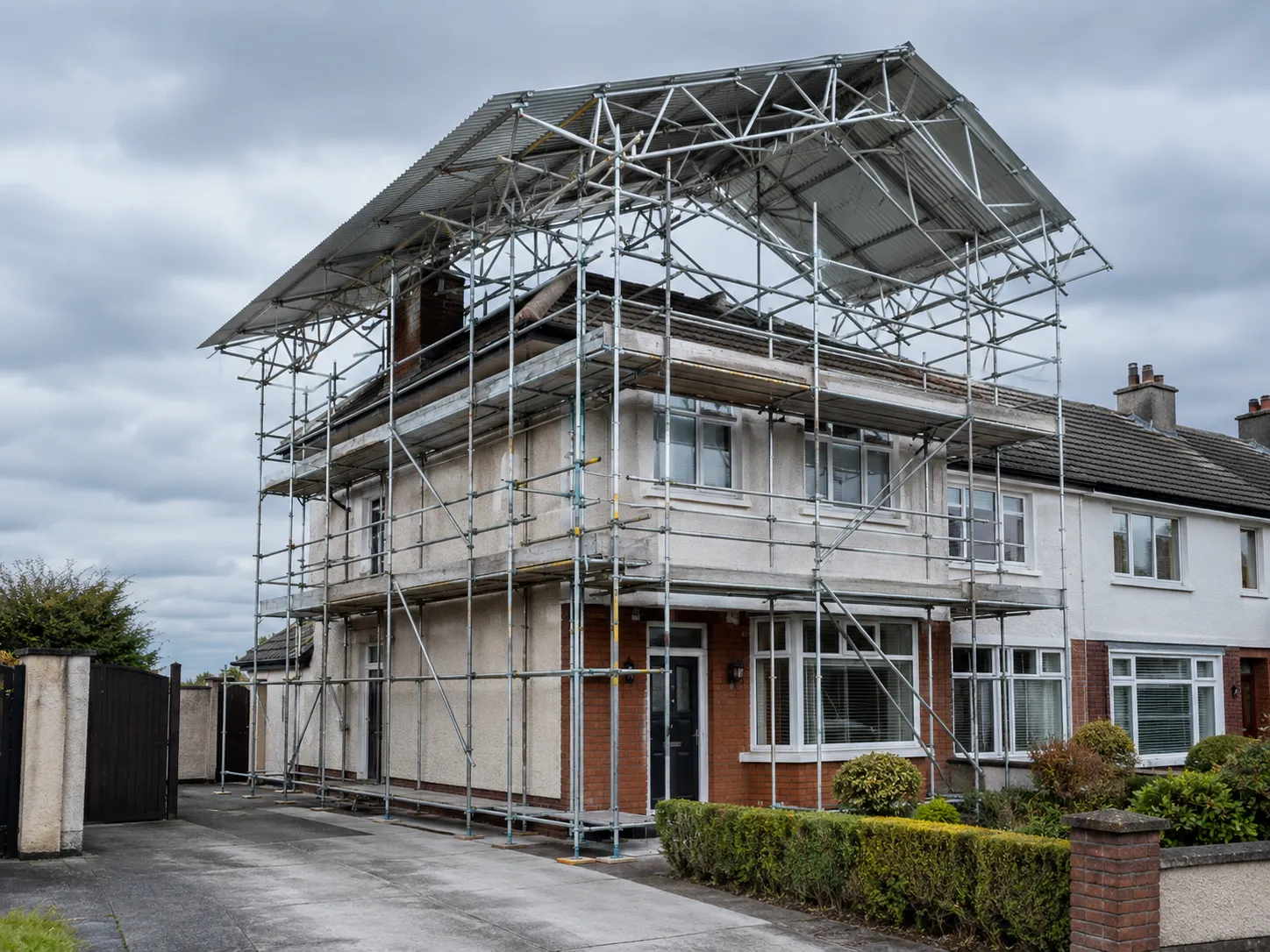
A modular aluminium temporary roof lattice frame erected over an access scaffold during an Irish re-roofing project.Single-use shrink-wrap cladding applied directly over an existing scaffold frame.
How Is a Temporary Roof Installed? (Step-by-Step)
Free site survey - Our engineers visit your site anywhere in Dublin or Ireland to assess access, roof dimensions, wind exposure, and load requirements.
Design and planning - A bespoke temporary roof layout is produced, including load calculations and a full method statement.
Scaffold erection - Our skilled scaffolding team installs the supporting scaffold structure using the Layher system, typically within one to three days depending on span.
Roof sheeting and enclosure - High-grade sheeting is fixed to the scaffold to create a weatherproof enclosure over the full working area.
Inspection and handover - The completed structure is formally inspected and handed over with a scaffold inspection certificate compliant with HSA guidance.
Ongoing inspection - Periodic inspections are carried out throughout the hire period and after any adverse weather event.
Safe dismantling - On project completion, the system is safely deconstructed and removed with minimal disruption to your site.
Our inspections are made possible by the depth of knowledge our scaffolding engineers have, by understanding every piece and every process that goes into constructing each section of scaffolding. The inspections are carried out at the erection and deconstruction of each scaffold, as well as at regular points during the life of each scaffold. Each scaffold should also be inspected after adverse weather conditions such as high winds or heavy rain, to ensure the structural integrity of the construction is of a high level.
Our inspections prevent against a multitude of scaffold related accidents such as falls, falling objects, structural instability, electrocution, and overloading. When you entrust us with the construction, inspection, or maintenance of your scaffolding you are gaining a wealth of scaffolding knowledge that is unparalleled in Ireland. Ainscaff’s focused is completely trained on scaffolding and because of this we are able to supply a high level of service and quality, thanks in part to our product specialisation.
Ainscaff Temporary Roof Engineering Capability
What distinguishes Ainscaff from many scaffold-only contractors is in-house structural engineering. Temporary roof scaffolds are not standard scaffold configurations; they carry wind and snow loads, span significant distances, and are subject to complex load paths through the scaffold structure to the ground.
A temporary roof designed without structural input may be unsafe under Irish winter wind conditions. Ainscaff engineers provide:
Roof frame design and structural calculations to EN 12811 and Irish wind load requirements
Scaffold structure design to support the temporary roof loads, including foundation assessment and sole plate specification
Load schedules for planning authority submissions where required
RAMS packs for all commercial and insurance restoration projects
Liaison with insurance loss adjusters and their appointed surveyors on scope, load assumptions, and access requirements
Temporary Roof Scaffolding for Insurance Restoration
A custom-engineered temporary roof designed for restricted loading over a listed heritage building in Ireland.An emergency temporary roof over a fire-damaged property, preventing secondary water damage during restoration.
Ainscaff has extensive experience of temporary roof scaffolding for insurance restoration projects, particularly fire and flood damage claims where rapid deployment of weather protection is required to prevent secondary damage escalating the claim value.
When a loss adjuster appoints a scaffolding contractor for insurance restoration work, the key requirements are: speed of deployment (every day without weather protection risks further damage); certified design (the temporary roof must be designed, not improvised); full insurance (the scaffolding contractor must be independently insured); and CIRI registration (many insurers now specify CIRI-registered contractors).
Ainscaff emergency response capability allows us to mobilise a temporary roof assessment and erection within 24-48 hours of instruction on most sites within range of our Dublin, Cork, and Galway depots.
How Much Does a Temporary Roof Scaffold Cost in Ireland?
A temporary roof scaffold in Ireland costs approximately €1,200–€2,000 per week for a standard domestic semi-detached house (combined base scaffold and temporary roof system, including erection and dismantlement). Larger domestic properties run €2,000–€3,500 per week. Commercial and large-span temporary roofs are priced on survey.
Most searches for temporary roof scaffold costs in Ireland return UK price guides quoting figures in sterling. This guide gives Irish euro pricing based on current rates from Ainscaff Scaffolding - a CIRI-registered contractor operating across Dublin, Cork, and Galway with over 40 years of temporary roof experience.
Temporary Roof Scaffold Cost in Ireland: Price Guide 2026
Project Type
Weekly Hire Cost (Incl. Scaffold)
Typical Hire Period
Notes
Standard domestic - terraced / semi-detached (up to 6m span)
€1,200 – €2,000 / week
3 – 8 weeks
Inc. base scaffold + temp roof + erection + dismantlement
Larger domestic - detached house (6m–9m span)
€2,000 – €3,500 / week
4 – 10 weeks
Wider span = more roof frame components
Large detached / dormer bungalow (full perimeter)
€2,500 – €4,000 / week
4 – 12 weeks
Complex geometry may require bespoke design
Shrink-wrap cladding (alternative to solid sheeting)
€800 – €1,500 / week (on existing scaffold)
2 – 6 weeks
Shrink-wrap applied over scaffold frame; single-use
Emergency fire / flood response
Typically 20–30% premium on standard rate
Mobilisation within 48–72 hours
Emergency deployment costs covered by most insurers
Commercial / industrial (large span)
Quote on survey
Project duration
Structural calculations and wind load design included
Note: All prices are indicative weekly hire rates including base scaffold, temporary roof system, erection by Ainscaff operatives, weekly inspection, and dismantlement. Final prices depend on project-specific factors set out below. All prices inclusive of VAT unless otherwise stated.
What Affects the Cost of a Temporary Roof Scaffold?
Roof span (width)The primary driver of temporary roof cost is the span - the width that must be bridged by the roof frame. A standard semi-detached house in Ireland is typically 5–7m wide, which falls within standard modular system spans. Properties wider than 9–10m require bespoke or extended span systems, which cost more in materials and design time.
Roof complexityA simple pitched rectangular roof is the most economical shape to cover. Properties with gable returns, dormers, bay windows at roof level, projecting chimneys, or L-shaped footprints require additional design and additional components to seal the junctions - increasing both cost and erection time.
Cladding type: solid sheet vs shrink-wrapSolid aluminium or steel sheet roofing panels are more expensive to supply and erect than shrink-wrap, but they are more durable and can be reused. Shrink-wrap is lower cost per application and better suited to complex roof shapes, but it is single-use and provides a less robust seal in very high wind conditions. See our temporary roof vs shrink wrap comparison.
Height and accessTaller buildings require more scaffold - more bay lifts, more material, more erection time. Properties with restricted access (narrow side passages, overhead cables, low outbuildings) take longer to erect and may require additional design for cantilever sections or alternative access.
Emergency response premiumFor fire and flood restoration projects requiring emergency deployment (mobilisation within 24–72 hours), a premium of typically 20–30% applies. This reflects the cost of reprioritising crews and materials at short notice. Emergency response costs are commonly accepted by insurance loss adjusters and can usually be included in the restoration claim.
Design requirementsFor standard domestic spans and configurations, Ainscaff’s temporary roof design is included within the standard hire cost. For non-standard spans, high-wind-exposure sites, complex roof geometry, or structural loading requirements above standard, additional design fees may apply. All projects include a standard wind load check, installed following appropriate scaffolding safety requirements.
Temporary Roof Cost vs the Cost of Not Using One
The most compelling financial argument for a temporary roof is the cost of the alternative: water ingress during roof works. A full re-roof with scaffolding costs substantially less than a re-roof with scaffolding plus internal redecoration, plastering, and structural drying following a wet weather event that got into an unprotected building.
Scenario
Typical Cost Implication
Temporary roof used throughout re-roof
Temporary roof scaffold cost: €1,200–€2,000/week for 4–6 weeks = €4,800–€12,000 total. Building remains dry throughout.
No temporary roof - wet weather event during re-roof
Water ingress to roof deck and ceiling. Drying, replastering, repainting ceiling: typically €3,000–€8,000 additional on a 3-bed semi. Plus delay to project.
No temporary roof - structural water damage during re-roof
Water damage to roof timbers, insulation, ceiling joists. Structural drying and repairs: €10,000–€30,000+ depending on severity and duration.
Get an Exact Price for Your Temporary Roof
The ranges above are indicative. A survey gives you a fixed weekly rate covering base scaffold, roof frame, cladding, erection, weekly inspection and dismantlement, with no separate scaffold charge.
Our temporary roof systems are used across a wide range of project types throughout Dublin and Ireland:
Roofing contractors replacing or repairing slate, tile or flat roof systems on domestic and commercial properties
Main contractors on new build housing schemes and apartment developments requiring ongoing weather exclusion
Conservation and heritage specialists working on protected structures in Dublin, Meath and Kildare
Industrial and pharmaceutical facilities carrying out planned maintenance shutdowns in live environments
Event organisers requiring temporary covered structures for outdoor occasions
Service Areas: Temporary Roofs Across Dublin and Ireland
Ainscaff operates depots in Dublin, Cork and Galway, enabling rapid deployment of temporary roofing systems to any location in Ireland. We regularly serve projects in Dublin City and County, Meath, Kildare, Wicklow, Cork, Galway, and nationwide for large-scale commercial contracts.
How Is a Temporary Roof Assembled, and How Long Does It Take?
The assembly Time Depends on the Size and Complexity of the Temporary Roof. However, Modern Systems, Like the Ones We Offer, Are Designed for Quick and Efficient Installation. Trained Professionals Can Typically Set Up a Temporary Roof Promptly. For more particular details contact us.
Are Temporary Roofs Customizable for Different Project Requirements?
Yes, Temporary Roofs Can Be Customized to Fit the Specific Requirements of Different Construction Projects. This Includes Adjusting the Size, Shape, and Configuration to Accommodate Various Structures and Layouts.
Can a Temporary Roof Be Used for Long-Term Projects?
Temporary Roofs Are Primarily Designed for Short to Medium-Term Use. However, They Can Be Used for Extended Durations with Proper Maintenance and Periodic Inspections to Ensure Structural Integrity and Safety. For more particular details contact us.
What is a temporary roof and when do I need one in Ireland?
A temporary roof is a weatherproof scaffold structure erected over a building or work area to protect it from rain, wind and other elements during construction or renovation work. In Ireland, where weather delays are a major cost driver, temporary roofs are recommended for any roofing project lasting more than a few days, phased refurbishments, heritage restorations, and industrial shutdowns.
How much does temporary roof hire cost in Ireland?
Temporary roof hire costs in Ireland vary by span width, site access, duration and system complexity. Contact Ainscaff for a free, no-obligation site survey and quotation tailored to your project. We offer competitive rates for both short-term domestic projects and extended commercial contracts.
Can a temporary roof be used for extended periods?
Yes. Temporary roofs are designed for short to medium-term use but can be maintained for extended durations with regular inspections. Ainscaff carries out periodic structural checks throughout the hire period and after any severe weather events to ensure ongoing safety and compliance.
Is Ainscaff's temporary roofing scaffold HSA compliant?
Yes. All Ainscaff temporary roof installations are designed and erected in compliance with Health and Safety Authority (HSA) guidelines and current European scaffold standards. Every structure is pull-tested, formally inspected and handed over with full documentation.
Do you offer temporary roofs for domestic reroofing projects in Dublin?
Absolutely. Ainscaff installs temporary roofing solutions for residential reroofing across Dublin and surrounding counties. Our systems protect your home during replacement of slates, tiles or flat roof membranes and can be erected and removed around your contractor's programme.
Can I use a temporary roof if I don't need a full scaffold?
A temporary roof is always supported on a scaffold structure; there is no freestanding temporary roof system that does not require scaffolding as its foundation. If you need a temporary roof, you will need a scaffold. The two are quoted together as a single package by Ainscaff.
How quickly can Ainscaff erect a temporary roof?
For emergency response projects (fire and flood restoration), Ainscaff aims to mobilise an assessment within 24 hours and erect a temporary roof within 48-72 hours of instruction, subject to site conditions and access. Standard projects are programme-planned from the survey stage.
Does Ainscaff provide temporary roofs for heritage buildings?
Yes. Ainscaff has experience of temporary roof scaffolding over listed and protected structures. In-house engineers can provide bespoke solutions for restricted loading conditions or unusual roof forms. We work with heritage architects, conservation consultants, and the National Monuments Service on heritage-sensitive projects.
Do you need a temporary roof for a partial re-roof?
A temporary roof is strongly recommended for partial re-roofing in Ireland, particularly between October and March. If the works are carefully phased and weather is monitored, some contractors manage without one during summer months, but the risk of water damage from an unexpected wet period is significant.
Is a temporary roof needed for fire damage restoration?
Yes. For fire-damaged properties, a temporary roof is typically the first action on the restoration programme. It prevents secondary water damage and is usually approved by insurance loss adjusters as part of the claim.
Is a temporary roof scaffold covered by insurance?
For projects triggered by insurance events (fire, flood, storm damage), the cost of a temporary roof scaffold is typically included in the insurance restoration claim. Ainscaff works directly with loss adjusters and can provide a formal quote for inclusion in the claim. CIRI registration and full insurance documentation are required by most insurers.
Does the temporary roof cost include the base scaffold?
Yes. Ainscaff quotes temporary roof scaffolding as an all-in package: base access scaffold + temporary roof frame + cladding + erection + weekly inspection + dismantlement. There is no separately quoted base scaffold - the pricing in this guide is for the complete system.
How does temporary roof scaffold cost compare to UK prices?
UK guides quote temporary roof scaffold at GBP3,500-GBP35,000 for domestic projects. UK prices do not apply directly to Ireland: different labour costs, material supply chains, VAT treatment, and the absence of UK government schemes affect the figure. Irish prices in this guide are based on current Irish market rates from Ainscaff's own pricing.
For further information, Contact Us! Follow us on LinkedIn for the latest updates.
Not Sure Which Option is Right for Your Project? Ask Ainscaff
Ainscaff Scaffolding designs and erects temporary roof scaffold systems and coordinates shrink-wrap cladding across Dublin, Cork, and Galway. Our free site survey includes a recommendation on the most appropriate weather protection for your project.