
Temporary Roof vs Shrink Wrap: Protecting Your Project from Irish Weather
There are two main weather protection options for scaffold-supported roof projects: a traditional temporary roof scaffold with solid sheeting, and shrink-wrap scaffold cladding. Both work - but they suit different projects, budgets, and site conditions.
When a building project exposes a roof - re-roofing, structural repairs, fire or flood restoration - the roof needs to be protected from rain. In Ireland, this is not a theoretical concern: rain is possible in any month, and even the driest parts of the country receive 700–800mm of rainfall per year with no reliably dry season.
There are two main weather protection options for scaffold-supported roof projects: a traditional temporary roof scaffold with solid sheeting, and shrink-wrap scaffold cladding. Both work - but they suit different projects, budgets, and site conditions. This guide explains the difference and helps you decide which is right for your project.
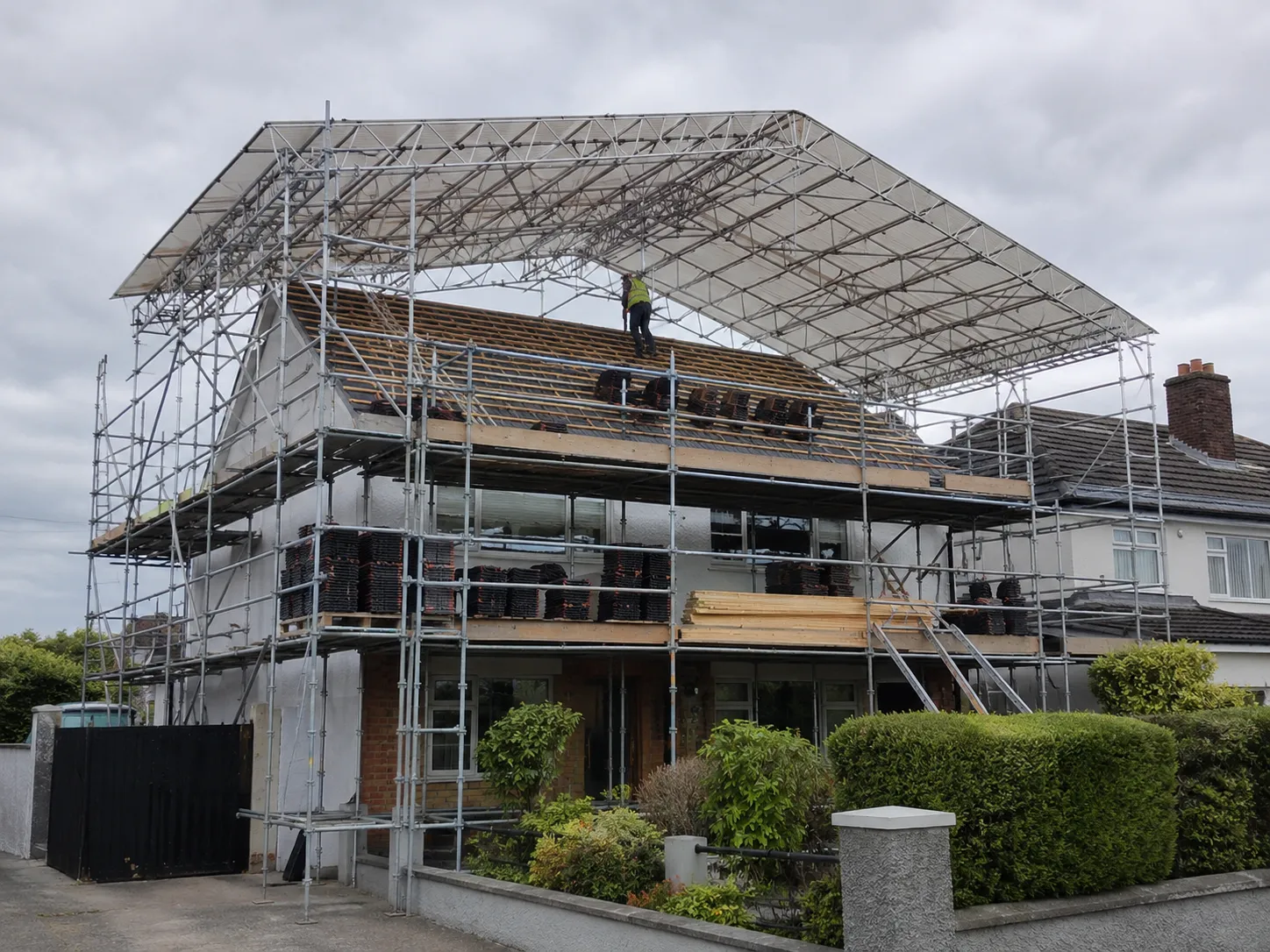
What Is a Temporary Roof Scaffold?
A temporary roof scaffold is a structural frame, supported on the access scaffold, that spans the building and is clad with solid aluminium or steel sheet roofing panels. It creates a rigid, weatherproof structure - essentially a temporary building within a building - that protects the roof below from rain, wind, and debris throughout the project.
A temporary roof scaffold is:
- 1A permanent-feeling, engineered structure - designed by engineers to wind load requirements
- 2Reusable - the aluminium frame and sheeting are recovered and used on multiple projects
- 3Available in standard spans (typically 6m–12m) and bespoke for larger buildings
- 4Strong enough to carry foot traffic for inspection and maintenance
- 5Clearly visible - a solid roof structure sitting above the building
What Is Shrink-Wrap Scaffold Cladding?
Shrink-wrap scaffold cladding is a specialist PVC membrane that is applied over a scaffold frame and heat-shrunk using a hot-air gun to create a taut, sealed surface. When correctly applied, shrink-wrap creates a fully enclosed weather barrier around the scaffold structure - not just over the roof, but potentially enclosing the entire scaffolded area.
Shrink-wrap cladding is:
- 1Applied by specialist trained operatives using heat guns - not a standard scaffolding operation
- 2Single-use - the membrane is cut away at the end of the project and cannot be reused
- 3Highly adaptable to complex shapes - can be applied over gable returns, dormers, L-shapes, chimney penetrations
- 4Able to fully enclose a scaffold structure - sides as well as top
- 5Lower upfront material cost than a solid aluminium system
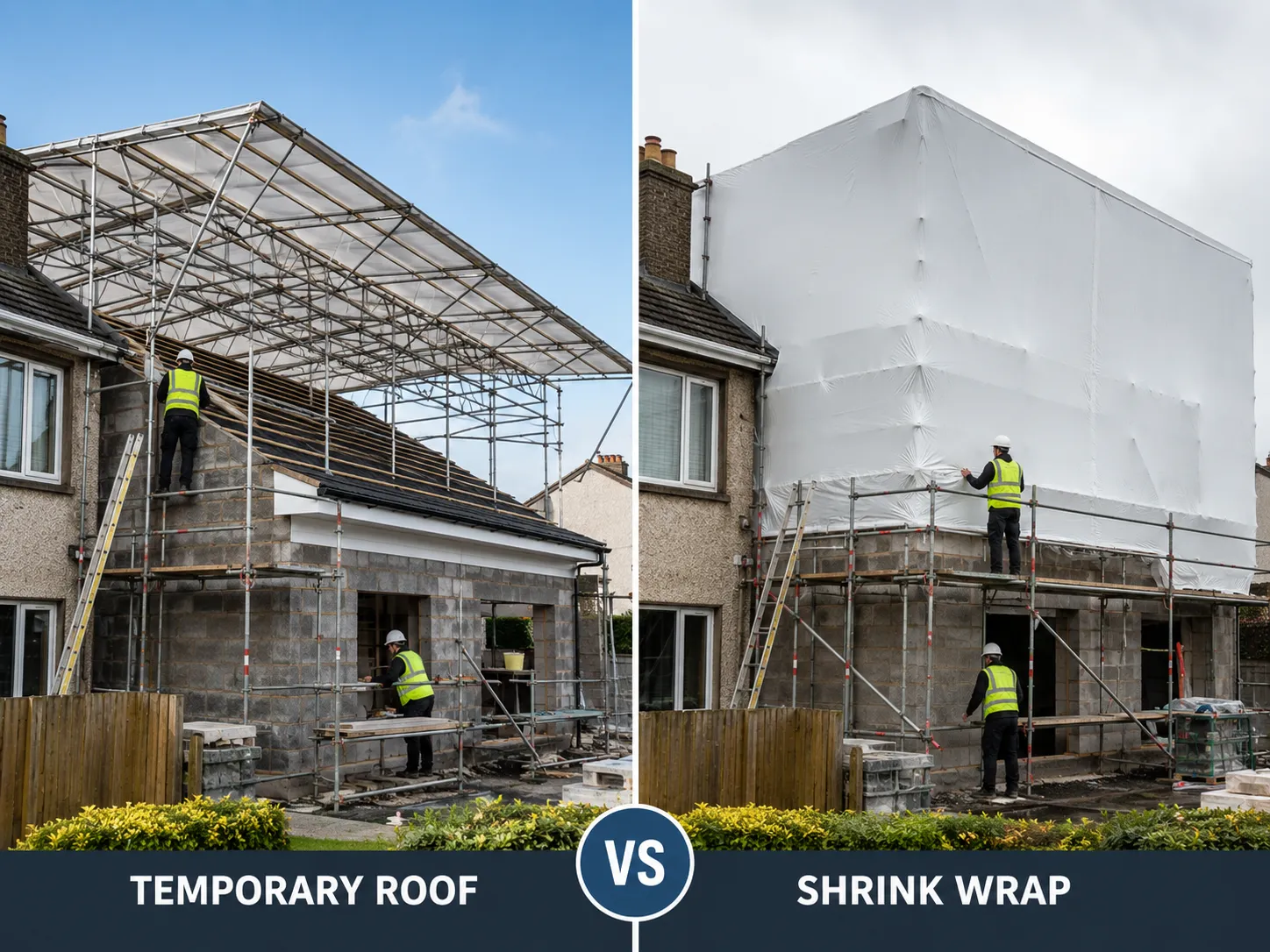
Temporary Roof vs Shrink Wrap: Side-by-Side Comparison
| Factor | Temporary Roof Scaffold | Shrink-Wrap Cladding |
|---|---|---|
| Weather seal quality | Excellent - solid sheeting, proven in high winds. Standard choice for full re-roofing. | Excellent when correctly applied. Fully enclosed option available. Less robust in sustained high-wind conditions than solid sheet. |
| Suitability for complex roof shapes | Good for regular pitched roofs. Gable returns and dormers need additional design and components. | Excellent - shrink-wrap adapts to any shape, including dormers, returns, and irregular geometry. |
| Cost (relative) | Higher upfront cost; frame components are reused across many projects. | Lower upfront cost per application; membrane is single-use. |
| Installation speed | Standard residential spans erected in 1 day by experienced crew. | Applied over erected scaffold; typically 1–2 days for a domestic property. |
| Reusability | Yes - frame and sheeting reused. Lower long-term cost on repeat projects. | No - single-use membrane. Cost per application includes disposal. |
| Enclosed workspace | Roof covered but sides open to weather (standard configuration). Closed sides possible but adds cost. | Full enclosure possible - sides and top all clad. Creates a weatherproof sealed work environment. |
| Load-bearing (foot traffic) | Solid sheeting can support inspection foot traffic. Designed for imposed loads. | Not load-bearing - membrane only. Operatives cannot walk on shrink-wrap surface. |
| Engineering design required | Yes - structural design for wind and snow loads. Ainscaff in-house engineers provide calculations. | Lighter design requirement. Shrink-wrap tension calculated per project. |
| Best for | Full re-roofing, structural roof repairs, heritage projects, insurance restoration with extended programme. | Complex roof geometry, full enclosure requirement, short-programme projects, dust or debris containment. |
Which Should You Choose for an Irish Roofing Project?
Choose a temporary roof scaffold if:
- 1The project is a full re-roof - all tiles or slates stripped and replaced
- 2The project duration is 4 weeks or more
- 3The roof shape is a regular pitched rectangle without complex geometry
- 4The project is a heritage or listed building where the works will be extended
- 5The building is occupied and the internal environment must be protected throughout
- 6You need to be able to walk on the temporary roof covering for access or inspection
Choose shrink-wrap scaffold cladding if:
- 1The roof has complex geometry - dormers, gable returns, irregular valleys - that makes solid sheeting impractical
- 2Full enclosure of the scaffolded area is required - for dust containment, hazardous material control, or thermal enclosure
- 3The project duration is short (2–4 weeks) and the lower upfront cost of shrink-wrap is attractive
- 4The scaffold erector can coordinate with a shrink-wrap specialist (Ainscaff can advise on suitable sub-contractors where required)
Can you use both?
Yes. On some projects - particularly large or complex re-roofing schemes - Ainscaff uses a combination: a solid aluminium temporary roof over the main roof area, with shrink-wrap applied to seal the difficult junctions (gable returns, chimney penetrations, dormer interfaces) where standard sheeting cannot achieve a complete weather seal.
The Irish Weather Angle
In the UK, shrink-wrap cladding has become popular partly because UK projects benefit from more predictable dry-weather windows in summer. In Ireland, particularly on the west and south coasts, the risk of a sustained wet spell is higher in every month. For this reason, Ainscaff's default recommendation for full re-roofing on properties above a semi-detached (i.e. wider spans or more complex geometry) is a solid aluminium temporary roof system - it is more robust in sustained wind and rain and does not risk the seal failure that can occur with poorly applied shrink-wrap in high winds.
Shrink-wrap remains an excellent option for the specific use cases above - complex geometry, full enclosure, containment requirements. But for straightforward Irish re-roofing, the temporary roof scaffold is the more dependable weather protection.
Not Sure Which Option Is Right for Your Project? Ask Ainscaff
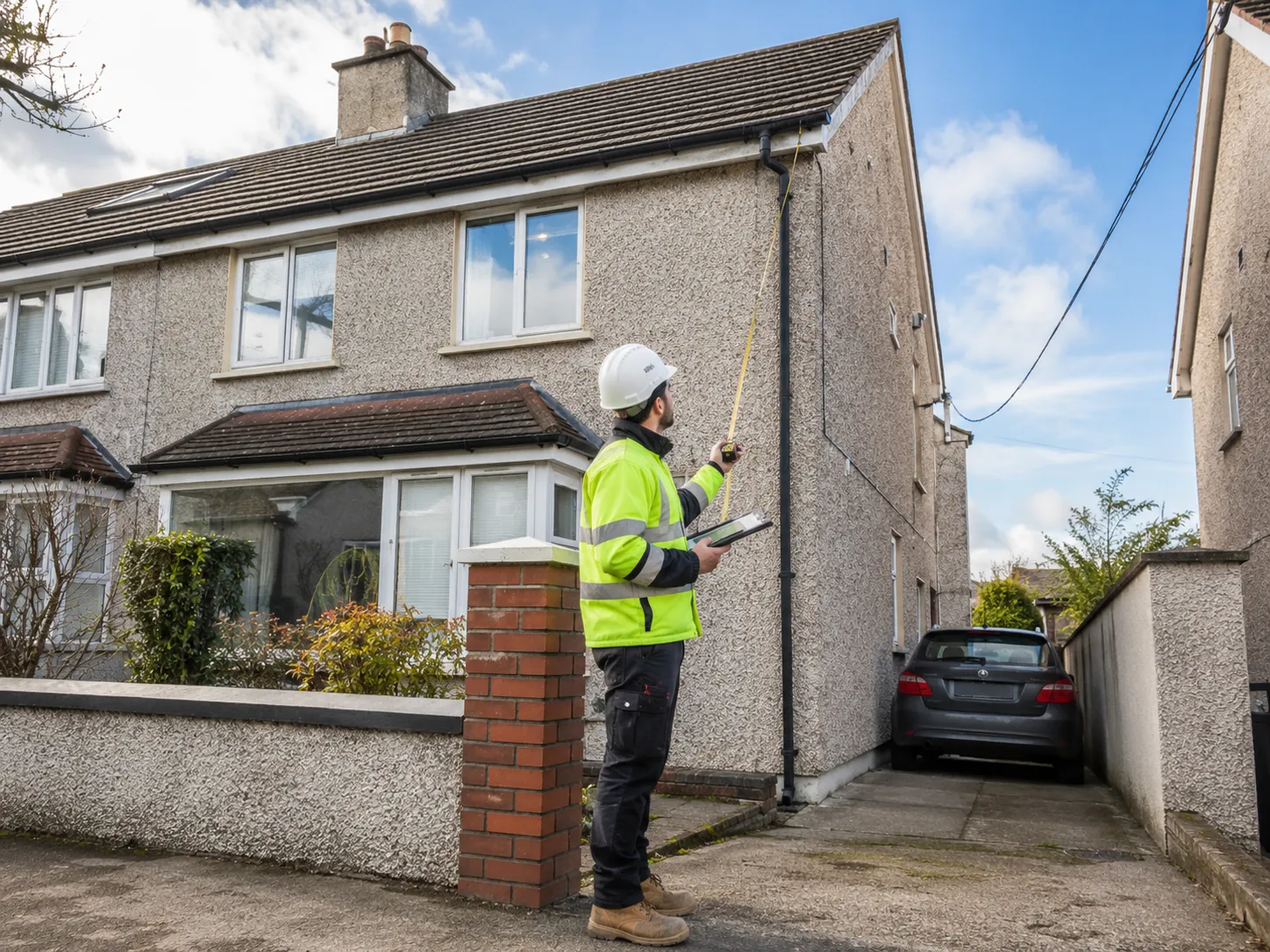
Ainscaff Scaffolding designs and erects temporary roof scaffold systems and coordinates shrink-wrap cladding across Dublin, Cork, and Galway. Our free site survey includes a recommendation on the most appropriate weather protection for your project. Contact us to arrange your survey.