
Scaffolding Ireland: Nationwide Hire & Erection
Ainscaff Scaffolding provides scaffolding hire and erection across the Republic of Ireland. With three permanent depot locations - Dublin, Cork, and Galway - Ainscaff operates as a single nationwide contractor, offering one company, one standard of work, and one point of contact for scaffolding projects anywhere in Ireland.
We are not a scaffolding material supplier. Ainscaff is a hire-and-erect contractor. That means we survey, design (where required), erect, inspect, maintain, and dismantle. Our clients range from Dublin homeowners extending their rear kitchens to multinational pharmaceutical companies managing planned industrial shutdowns at their Cork and Galway campuses.
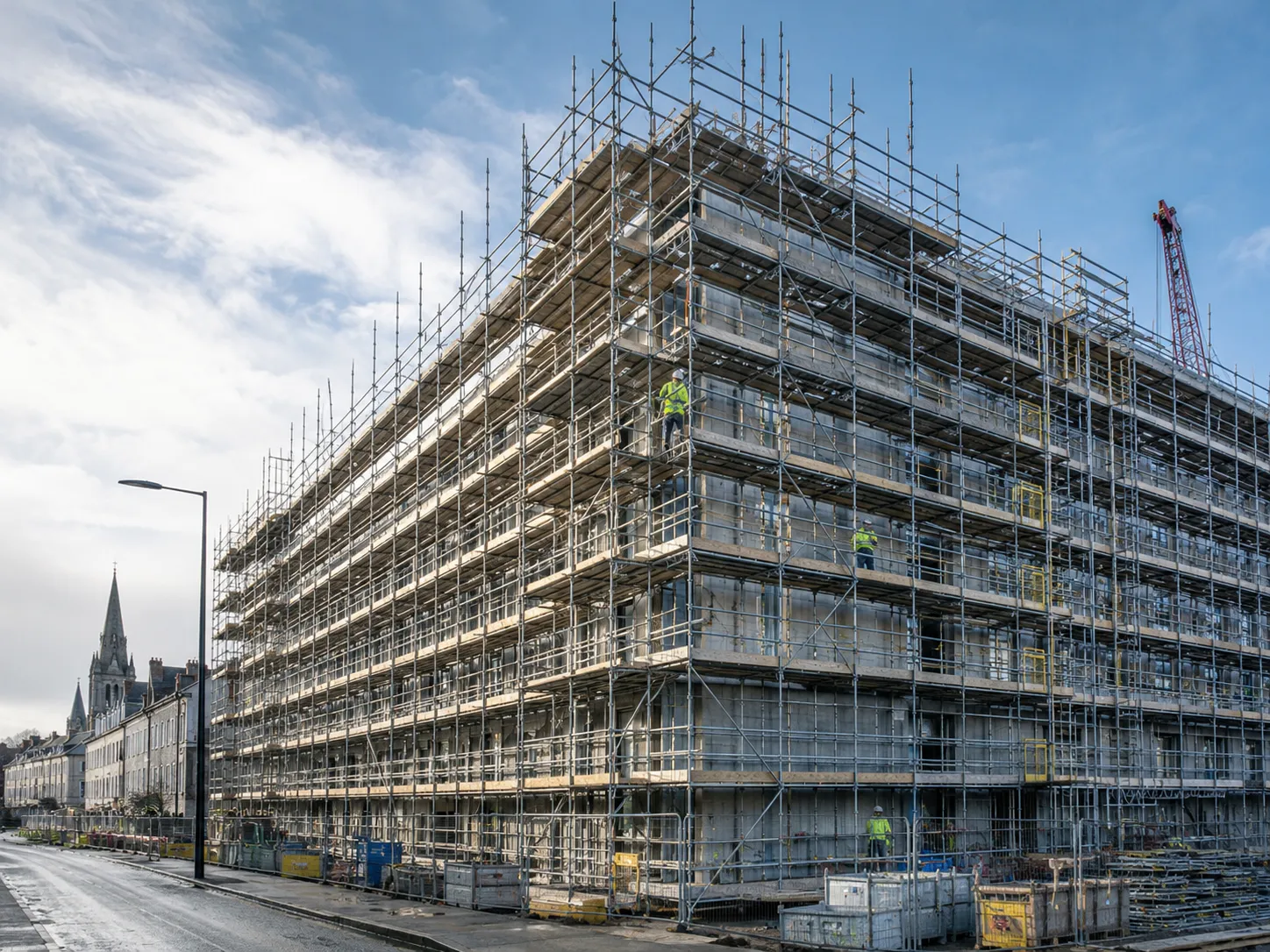
Why Choose a Nationwide Scaffolding Contractor?
When searching for scaffolding in Ireland, the results include material suppliers (Scafftex, Layher, Haki), DoneDeal sales listings for second-hand tubes and boards, and job advertising platforms. These are not scaffolding contractors - they cannot survey your project, design a scaffold, erect it, inspect it weekly, and dismantle it at the end.
Ainscaff is a hire-and-erect contractor. The distinction matters: a hire-and-erect contractor takes responsibility for the scaffold structure from the moment it is erected to the moment it is removed. Our name goes on the handover certificate. Our engineers design the structure. Our operatives erect and inspect it. If anything needs to change during the hire period, we attend.
For main contractors and procurement teams managing scaffolding needs across multiple sites or regions, working with a single nationwide contractor simplifies procurement, provides one insurance certificate, one RAMS pack, and consistent safety standards across every project.
Scaffolding Services: What Ainscaff Provides
| Service | Detail |
|---|---|
| Site survey | Free survey for all projects. Residential: 20-30 minutes. Commercial: full survey report produced. |
| Scaffold design | In-house structural engineers provide load calculations and design drawings to EN 12811 / TG20:21 standards. |
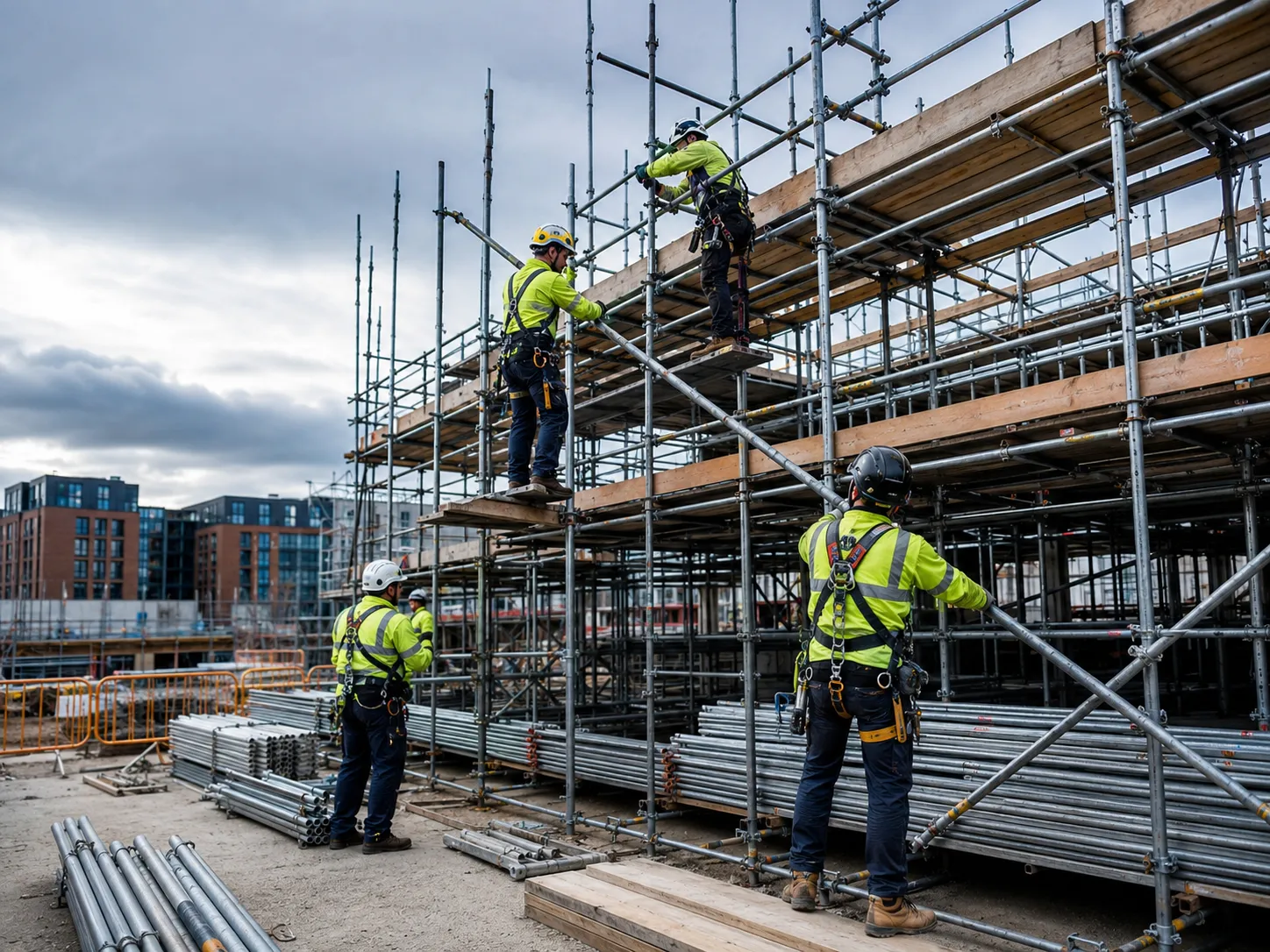
| Erection | All erection by Ainscaff's own Safepass-certified operatives. Handover certificate issued on completion. |
| Weekly inspection | Mandatory weekly inspection included in hire cost. Inspection records maintained throughout hire period. |
| Adverse weather inspection | Scaffold inspected after any significant wind or weather event before resuming work at height. |
| Scaffold adaptation | Modifications during hire (additional bays, height extensions, loading changes) with revised certificates. |
| Temporary roofs | Weather-protection systems for re-roofing, restoration, and continued-works-in-rain. See temporary roofs. |
| Dismantlement | Removal of all components. Site left clean. Completion confirmation issued. |
| RAMS packs | Risk Assessments and Method Statements produced for all commercial and industrial projects as standard. |
Scaffolding Dublin
Ainscaff's primary depot is in Dublin, serving the full Dublin metropolitan area and greater Dublin commuter counties (Wicklow, Kildare, Meath, Louth). The Dublin depot handles the full range of residential, commercial, and industrial scaffolding and manages the nationwide coordination function. See our dedicated scaffolding hire Dublin page.
Ainscaff is currently ranked in the local pack for 'scaffolding hire dublin', reflecting 40 years of established operation in the Dublin market. Our Dublin client base spans house extensions and re-roofs in south county Dublin through to pharmaceutical and technology campuses in the city and Wicklow enterprise zones.
Scaffolding Cork
Ainscaff's Cork depot services scaffolding hire and erection across Cork city, Cork county, and the surrounding Munster region. Cork depot clients include industrial and pharmaceutical facilities along the Cork Harbour and Ringaskiddy corridor, commercial construction in Cork city centre, and residential projects across south and west Cork.
The Cork depot is staffed by Ainscaff's own Safepass-certified operatives and operates to the same design, inspection, and safety standards as the Dublin office. For Cork scaffolding enquiries, contact Ainscaff's main office - all depot coordination is managed centrally.
Scaffolding Galway
Ainscaff's Galway depot covers scaffolding hire and erection across Galway city, County Galway, and the wider Connacht region. Galway depot projects include pharmaceutical and medical device facilities in the Galway enterprise zone (Parkmore, Mervue), commercial construction in Galway city centre, and residential scaffolding across the county.
As with Dublin and Cork, Galway projects are managed by Ainscaff operatives with the same certification and inspection regime. Single-point of contact: all Galway enquiries handled through Ainscaff's main office.
Nationwide Scaffolding Coverage: All 26 Counties
While Ainscaff's three depots anchor coverage in Dublin, Cork, and Galway, the company covers all 26 counties of the Republic of Ireland. For projects outside the immediate depot areas - Limerick, Waterford, Kilkenny, the Northwest - contact Ainscaff with your project details and we will confirm coverage and lead times.
| Leinster | Munster | Connacht | Ulster (ROI) |
|---|---|---|---|
| Dublin, Wicklow, Kildare, Meath, Louth, Westmeath, Longford, Offaly, Laois, Carlow, Kilkenny, Wexford | Cork, Kerry, Limerick, Tipperary, Waterford, Clare | Galway, Mayo, Sligo, Leitrim, Roscommon | Donegal, Cavan, Monaghan |
Scaffolding for Commercial and Industrial Clients
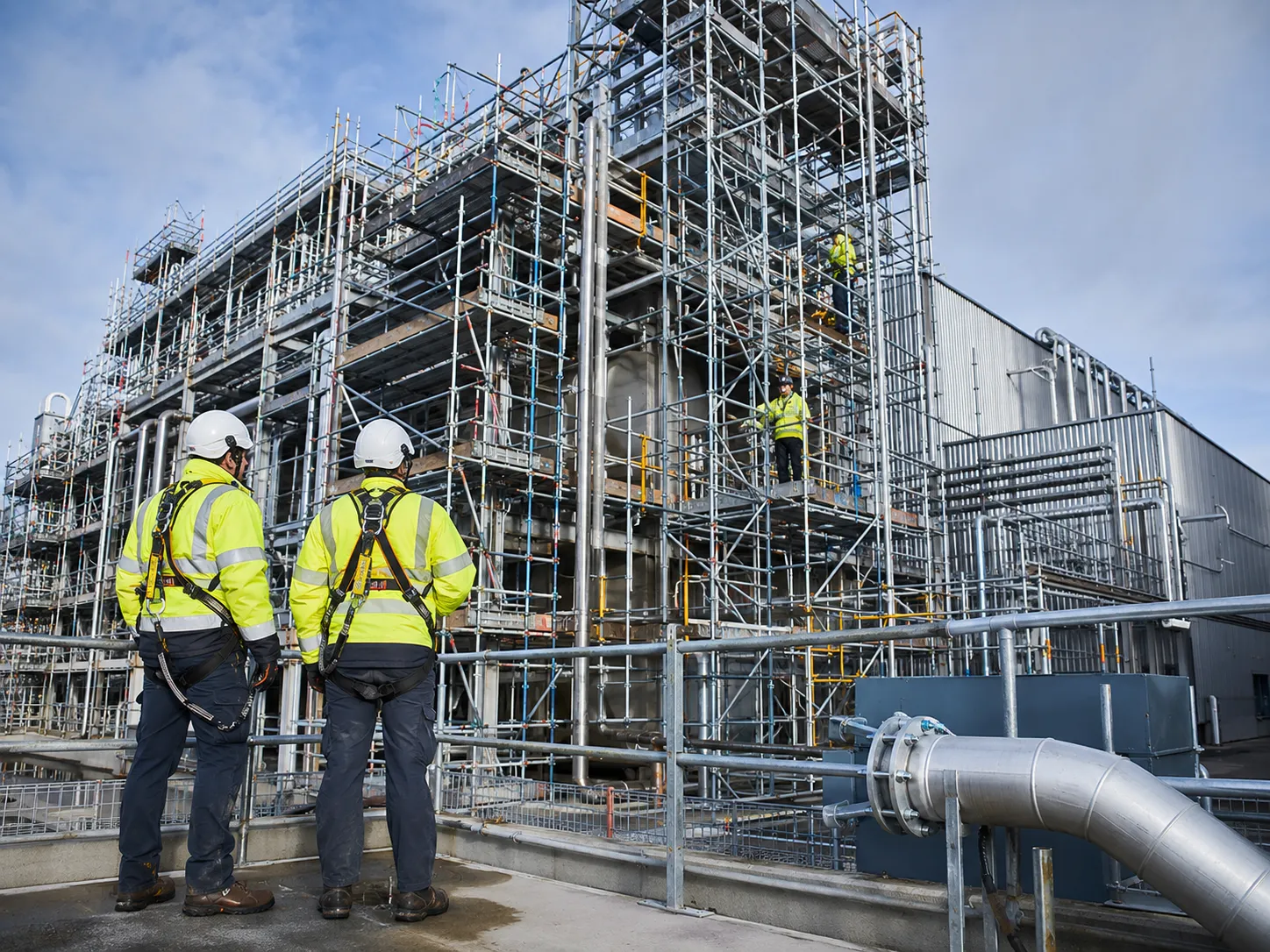
Ainscaff's commercial and industrial scaffolding division serves main contractors, facilities management companies, pharmaceutical and medical device manufacturers, utilities, food processing, and public sector clients across Ireland. Commercial scaffolding engagements typically involve:
- Formal scaffold design with structural calculations to EN 12811
- Loading schedule documentation (imposed loads, materials storage, equipment)
- RAMS packs and CDM compliance documentation
- Coordinated access management (traffic management, footpath licensing, overhead power)
- Inspection records available in real time for health and safety files
- LOLER-compliant inspection for suspended scaffold and hoist systems
Ainscaff's in-house engineering capability means we can design scaffolding solutions for non-standard applications - including structures inside operating pharmaceutical plants, on live highways, or at interfaces with listed building facades - where standard configurations do not apply.
Choosing a Scaffolding Contractor in Ireland: Certification & Insurance
Scaffolding is work at height. A scaffold that is incorrectly designed, poorly erected, or inadequately maintained is a serious risk - to the operatives using it, to the public passing below, and to the property owner who has ultimate responsibility for safe access on their site. Choosing the right scaffolding contractor is not just about price. It is about verifying that the contractor has the qualifications, registration, insurance, and inspection regime to take legal and professional responsibility for the scaffold structure for the duration of your project.
The Non-Negotiables: What Every Scaffolding Contractor Must Have
- CIRI registration. The Construction Industry Register Ireland (CIRI) is the statutory register for construction contractors, maintained under the Building Control (CIRI) Act 2014. A CIRI-registered contractor has been independently assessed for competence, health and safety management, and quality of work. Its absence is a red flag - verify any registration number at ciri.ie.
- Safepass certification. Under the Safety, Health and Welfare at Work (Construction) Regulations 2013, every operative on an Irish construction site must hold a valid Safepass card. Any operative without one is working illegally and their employer is in breach. Ask the contractor to confirm in writing that all operatives attending your site hold valid Safepass cards.
- Public liability insurance. Must cover the scaffolding activity and the value of the property and third-party liability. Minimum recommended cover is €6.5 million; many commercial clients specify €13 million or higher. Always ask for a current certificate and check the named insured matches the company doing the work.
- Employers' liability insurance. Separate from public liability, this covers claims from the contractor's own operatives if injured on your site. A contractor without it is in breach of Irish law, and an injured operative may in some cases claim directly against the property owner.
What to Ask Before Engaging a Contractor
| Question to Ask | What a Good Answer Looks Like |
|---|---|
| Are you CIRI registered? | Immediate confirmation and a CIRI number you can verify at ciri.ie |
| Can all operatives show a valid Safepass card on site? | Immediate confirmation. Ask this before the first day on site. |
| Can I see your current public liability insurance certificate? | Document showing current cover, correct named insured, scaffolding activity covered, minimum €6.5m |
| Will you provide a written quote? | Written quote with scaffold type, weekly rate, hire period, erection and dismantlement included. No verbal-only pricing. |
| Will you visit the site before quoting? | Yes - for any project above a one-bay chimney tower, an unseen quote is unreliable. |
| Who erects the scaffold - your own staff or subcontractors? | A reputable contractor uses their own operatives, not subcontractors unknown to them. |
| Do you inspect the scaffold weekly? | Yes, and after adverse weather. Inspection records maintained and available. |
| Will you provide a handover certificate on completion? | Yes - a handover certificate confirms the scaffold is safe to use. |
| Do you provide load calculations for this project? | For non-standard domestic and all commercial projects: yes, with in-house or named structural engineers. |
Red Flags: When to Look for a Different Contractor
Walk away if your scaffolding contractor:
- Cannot or will not provide a CIRI registration number
- Cannot confirm in writing that operatives hold valid Safepass cards
- Cannot provide a current public liability insurance certificate
- Quotes verbally only, with no written confirmation of price or scope
- Will not visit the site before providing a quote
- Cannot say clearly whether erection is done by their own staff or unknown subcontractors
- Cannot confirm a weekly inspection regime and inspection-record retention
- Does not issue a handover certificate on completion of erection
- Cannot provide load calculations for a non-standard or commercial project
- Offers a price significantly below competitors without a clear explanation
CIRI Registration vs Safepass: The Difference
These are different things. CIRI is a company-level registration - it assesses the scaffolding business against standards for competence, quality, health and safety management, and insurance. Safepass is an individual-level certification held by each operative and renewed periodically. A CIRI-registered company should employ Safepass-certified operatives, but CIRI registration does not automatically mean every operative on site holds a current Safepass card - ask for both.
Scaffolding Regulations & Safety in Ireland
Scaffolding is one of the most heavily regulated activities in Irish construction, because it is also one of the most common causes of serious injury and fatality on site - falls from height account for a disproportionate share of construction fatalities reported to the Health and Safety Authority (HSA) each year. For main contractors, Project Supervisors for the Construction Stage (PSCS), facilities managers, and site owners, understanding the regulatory framework is not optional.
The Core Regulatory Framework
| Regulation / Standard | What It Covers |
|---|---|
| Safety, Health and Welfare at Work (Construction) Regulations 2013 (SI 291/2013) | The primary Irish construction H&S regulation. Covers scaffold erection by competent persons, Safepass requirements, inspection duties, documentation. |
| Safety, Health and Welfare at Work (General Application) Regulations 2007 - Part 4 (Work at Height) | Working at height generally: hierarchy of controls, guard rails, ladder angle, working platforms. |
| Safety, Health and Welfare at Work Act 2005 | The overarching H&S framework: duties of employer and employee, and duty of care to third parties and the public. |
| EN 12811-1:2003 (Temporary Works Equipment) | European standard defining load classes, stability requirements, platform widths, and guardrail specifications. |
| TG20:21 (Temporary Works Design Guide) | The industry design guide for tube-and-fitting scaffolding, used across the UK and Ireland. |
| LOLER (Lifting Operations and Lifting Equipment Regulations) | Applies to lifting operations and suspended (swing-stage) scaffold; requires LOLER inspection by a competent person. |
Who Is Responsible for Scaffolding Safety?
The scaffolding contractor designs the scaffold (or commissions a design) appropriate for the load and height, erects it to the design, issues a handover certificate on completion, inspects it weekly and after adverse weather, maintains inspection records, and dismantles it safely at the end of the hire.
The Project Supervisor for the Construction Stage (PSCS) has overall responsibility for coordinating health and safety during construction - ensuring the contractor is competent (CIRI registered, insured, Safepass-certified), that the design is appropriate, and that inspection records are in the safety file.
The client / property owner has a duty of care under the 2005 Act to ensure persons on site are not exposed to risk from inadequate scaffolding: engage only a CIRI-registered, insured contractor; do not modify the scaffold; ensure it is inspected as required; and do not allow access before a handover certificate has been issued.
Scaffold Inspection Requirements
Under the Construction Regulations 2013 (Schedule 8), scaffolding must be inspected by a competent person:
- Before it is taken into use for the first time - a pre-use inspection recorded on the handover certificate
- At intervals not exceeding 7 days thereafter - a weekly inspection, with a written inspection record retained
- After any event likely to have affected its stability or load-bearing capacity - high winds, storm, or impact
- After any modification, extension, or partial dismantlement
A competent person is someone with sufficient training, experience, and knowledge to identify the defects the inspection is intended to find. A Safepass card alone does not make a person competent to inspect scaffold - the inspector needs scaffolding-specific knowledge. Ainscaff's inspection regime is built into our hire cost: weekly inspections are standard, not an optional extra.
What a Scaffold Inspection Report Must Record
- Date and time of inspection
- Location of the scaffold and the structure it serves
- Description of the scaffold and its components
- Any matters identified that could give rise to a risk to safety
- Any action taken as a result
- Name and signature of the person carrying out the inspection
Inspection records must be retained for at least 3 months after the scaffold is dismantled and must be available to the HSA on request.
Common Scaffolding Failures Found by HSA Inspectors
- Incomplete or missing guardrails - top or intermediate rail absent from working platforms
- Absent or inadequate toe boards - the 150mm minimum toe board not fitted
- No inspection records - scaffold in use without evidence of weekly inspection
- No handover certificate - scaffold in use without completion confirmation from the erector
- Overloading - materials stored beyond the design load class
- Unsecured ladders - access ladders not tied at the top and not set at the 4:1 angle
- Incomplete erection - a partially completed scaffold put into use before sign-off
- Modifications by site workers - bays, boards, or ties removed without the scaffolding contractor
Safepass: The Minimum Standard for Site Workers
Every operative on an Irish construction site must hold a valid Safepass card - a one-day safety awareness programme regulated by SOLAS, renewed every 4 years, and registered in the SOLAS national database. Safepass is a minimum standard covering general site-safety awareness, not scaffolding-specific training. Scaffolding operatives should hold Safepass plus sector-specific scaffolding competency training. All Ainscaff operatives hold valid Safepass and have completed scaffolding-specific training.
Scaffolding Ireland: FAQs
-
Does Ainscaff cover all of Ireland or just Dublin?
Ainscaff operates three depot locations - Dublin, Cork, and Galway - and covers all 26 counties of the Republic of Ireland. Contact us with your project location and we will confirm depot assignment and lead times. -
Can Ainscaff supply scaffolding materials only?
No. Ainscaff is a hire-and-erect contractor. We do not supply materials for customer self-erection. All Ainscaff scaffolding is erected, inspected, and dismantled by our own Safepass-certified operatives. -
What certifications should a scaffolding contractor in Ireland have?
A scaffolding contractor in Ireland should be registered with CIRI (Construction Industry Register Ireland) and employ Safepass-certified operatives. They must also hold current public liability insurance (minimum €6.5m) and employers' liability insurance. -
How often must scaffolding be inspected in Ireland?
Scaffolding must be inspected before first use, at intervals not exceeding 7 days, after any adverse weather event, and after any modification. Inspection must be carried out by a competent person and records retained for at least 3 months after dismantling. -
Is CIRI registration required for scaffolding contractors in Ireland?
CIRI registration is not legally mandatory for all contractors, but it is the established standard for Irish construction contractors and is required by many public sector and commercial clients. Absence of CIRI registration is a significant red flag. -
Is Ainscaff registered and what certifications do its operatives hold?
Ainscaff Scaffolding is registered with the Construction Industry Register Ireland (CIRI), and all operatives hold valid Safepass cards with additional scaffolding-specific training. Our in-house engineers hold Chartered Engineer status, and we carry full public and employers' liability insurance. CIRI number available on request.
Ainscaff provides scaffolding hire and erection across Ireland.
Dublin, Cork and Galway depots. Residential, commercial and industrial. 40 years experience, CIRI registered, fully insured, with weekly scaffold inspections as standard.